
Finding
the lost

“An adventure is an expedition gone awry.” ~ motto above the fireplace in large letters, reading room, Royal Geographical Society Anno Domini 2000
A long time ago I went on a camping trip with my family from a college town in Kansas all the way to Fairbanks, Alaska. Mountains were hiked. Yellowstone was seen. Fish were caught. Wildlife were everywhere. The Alaska-Canada highway was miserable. It was fun.
More recently, toward the turn of the millennium, I was asked to travel in the hinterland of Africa to a place that was widely promoted as being promisingly free of tyranny. We first got me across the Atlantic to London. There I met up with my late friend Michael van Notten who found us lodging. I walked over for a meal to the Embassy of the Republic of Texas which is, as you might imagine, a steakhouse. It also is in the building which was originally the embassy and bears an appropriately English little brass plaque denoting its part in the vast play of historical events. Atop the building was a flagstaff flying one of the largest state of Texas flags I’ve seen.
We had a little time for meeting with investors and visiting different parts of the region. So I walked to the Royal Geographical society and found their reading room. It included books on my destination, including one published in AD 1856 after the travels of one Richard Burton purporting to be the “First footsteps in East Africa” which, when you think about it, is more or less as arrogant as a guy can get in the title of a book. Well, there were plenty of other books on the matter, including at the nationalist socialist archives in Kew Gardens which is about as “ministry of information retrieval” as you would like a place to never be. I mention these points because when you are planning to hike in places you’ve never been, do some research. Maybe check out the forecasted weather expectations. You know, basic stuff.
And there, in the reading room, in letters about ten inches high, gold looking things they were, it said, “An adventure is an expedition gone awry.” I will tell you, some day, about some of my adventures when various expeditions have gone awry. But this is not that day.
Thwarted persistence
There are things that people agree to not discuss. An entire class of agreements is called “non-disclosure agreement” and has the charming if miserable acronym NDA. To be very clear about such matters, the intention of the agreement is to not discuss the names of the parties, the amounts invested, the nature of the technology, the actual and perceived market for the products, and other aspects of a business situation. It is in honour of those intentions that I am writing about this matter in the way that I am, though it is my understanding that the period of non-disclosure has elapsed and it is clear that the intentions of the other parties were less than honourable when the matter came to my attention later.
You should also be aware that non-disclosure agreements typically have fundamental failings that prevent them from actually being enforced. Among these failings, few such agreements involve an actual and verifiable exchange of value. Information is sent back and forth, but does it have any value? Is any amount paid for participating in the disclosures? If not, there is probably not an actual agreement, as defined under law, because there is no exchange of value. So it is often difficult to get any court to examine these matters and when that happens, also difficult to establish the value involved or any amount of “harm” to be recovered. These are facts known throughout the industries that are variously called private equity, venture capitalism, vulture capitalism, and investor madness. You should be sceptical of any agreement put in front of you, sign far fewer than you are shown, and never be afraid to bring a big red pen.
The stricken faces of the lawyers in the room when you begin to vocally cry out, “No way!” and mark off an entire paragraph, or entire page, or many entire pages, will be worth the price of admission. Tearing pages out of their bound documents and throwing them on the floor can also be a dramatic negotiating tactic. When you are being asked, in legalese, to consume bovine waste product, don’t hesitate to retort in kind. Any agreement that takes more than one page to summarise and more than ten to execute is probably not a good thing for you.
All of which is prefatory to the facts of this matter. It was almost a decade ago. I was asked to review the product offerings of an encrypted communications service provider. They had interesting tech and they had a reasonably effective marketing campaign. One of their products was up and running in a kind of beta testing mode with perhaps some load limit testing. The other was well designed, including manufacturing details, but not yet deployed.
The encrypted chat, voice, and file transfer service was fairly good. It used open source protocols with which I have become very familiar, in part because of the due diligence of the capital investment that was being proposed. Many digits were involved. I won’t say how many. There are two successful encrypted chat tools that I like fairly well and use regularly which are based on roughly the same code base and comparable technologies. I shall also not name them. My purpose is not to make invidious comparisons. My purpose is a cautionary tale, which I think you can understand just as well without naming names, even of competitors that didn’t exist at the time of the persistent effort me and the others on our team made to evaluate the investment.
Besides which, it is not really about the thwarted persistence of our team or the difficulties inherent in investing in startup operations. Nor has the entire matter come to any final conclusion, so there’s enough said about those parts.
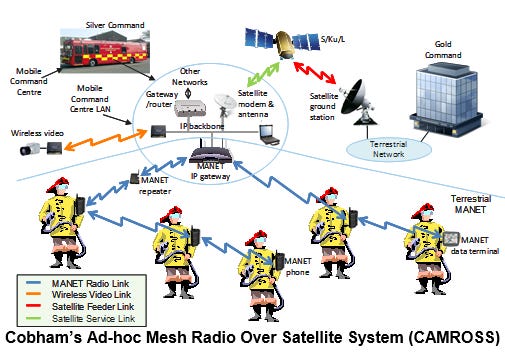
But the other thing they developed, marketed, and had at a very high level of conceptual and engineering development was a search and rescue appropriate mesh networks technology that included a handheld waterproof device that could be air dropped in large quantities and would survive impact with water, after which it would float. With a very small drogue chute these could also be dropped over land. They were so inexpensive that the devices that didn’t survive impact could be written off and the remaining devices were able to form a mesh network amongst themselves, with nearby base stations, and with circling aeroplanes carrying appropriate equipment. It was a nifty technology.
Getting lost
Have you? It is an interesting experience. You set off in a direction that you think you understand. But the undergrowth can be vicious. Smilax is among the very worst.
If you have not had the experience of walking into a temperate rainforest with long hanging tendrils of pleasant looking heart-shaped leaves, sometimes with tender and tasty fruits, only to find your garments being ripped apart by “saw brier” or your unclothed skin on arms or legs bloodied in moments, consider yourself blessed. It is not a good thing, any more than the ancient smilodon was any good. That Greek root “smylee” as we might say means scalpel and the don part means “tooth” as in the “dontic” part of orthodontic. Sabre toothed tigers were wiped out due to a massive impact event at the start of the Younger Dryas over fourteen thousand years ago. Smilax is with us to this day.
Getting untangled you continue along the hillside where you know you’ve seen a path, and on finding it you proceed downhill. In the distance between the trees you see what looks familiar, like a lake or pond, and you check your compass bearing to be confident of your direction. Carrying on, you cross what seems to be a dry streambed that drains toward that body of water you just saw. Then down a slope, and up another, and here is indeed a path. But it isn’t the path on which you’d ever been before, nor the one you’d seen. Soon it begins raining. Soon you check your phone for signal and there is none.
On and on you walk and find more paths, another body of water, and a rugged road of sorts that terminates in some six and ten year old cedar saplings. Passing beyond these, you find yourself again in wilderness. So you move carefully, steadily ahead. Here is a fence. Well, crossing a fence is evidence that you are trespassing, so you begin to call out, “Lost hiker. Need help.” No answers. Across a ravine that is far too steep to descend without ropes you see a residence. No lights. Nobody home. On you go. Another fence. Checking the compass doesn’t prove useful, except to be on a consistent heading so as to avoid going in circles. Yes, there is a legal exemption for being lost that means you are not technically trespassing, and no that doesn’t work as a bullet proof vest in the event a homeowner wants to shoot first and ask questions later. So you keep calling out “Lost hiker. Need help.” To little avail.
Now there is a steep descent, another fence, and behold, a view of a road further downhill. An actual paved road? No, but one of those county-miserably-maintained gravel roads that provide forest access. Okay! But that steep descent led to the loss of your favourite garden shears, which is your first best defence against smilax and the dreaded lacerations of clothing, skin, and gear. Thus, always carry a spare, even if it is a bit more balky when it comes to fully closing. Shear madness indeed.
Well, the road reached, the water has run out. Now you are still a lost hiker, but no longer easily confused with a trespasser, so you take a deep breath and check compass heading. Two directions are before you, left and right. Neither is familiar. So you choose and go up the road a ways. And a ways further. Maybe a mile and a half further you hear a car coming. It’s a Jeep type sport utility vehicle. The driver stops. Offers water. Offers a ride. Helps you get seated. Drops you off at the property you were working which turns out to be about six miles from where you were picked up. Fun.
No, it doesn’t count as an adventure. No gunfire, no flights of arrows shooting out of cavern walls, no giant man-traps, no Indiana Jones style escapades. Even as an expedition it doesn’t come to more than “management by wandering around” to see the scope of the problems involved in turning a spread of forested land into a community.
If you’ve had the experience of being lost, you know that it can be difficult to get unlost. It is non-trivial when you think about it.
The whole point of wilderness is that you are away from other people and their systems. Your cell phone might not work. You might not have brought a satellite phone. You might have enough water to go a ways, but how far? You have a compass heading, but where’s your map? Is it on your phone? And is it failing to update? Does your GPS system even work when the battery dies? You have a big backpack, but did you include a big battery backup? Really? And a boat anchor, too? You are strong like ox!
Deployable communications
From the narrative above you can see that it all worked out. Yes, it was tiring. No, it wasn’t deadly. Not even so much as a rustle in the leaves from a venomous snake, of which there are six species in that area. The cool thing about a narrative is that it implies the existence of a narrator.
The tricky part is, supposing you are gone long enough that the people you told you would be out and about are able to understand that you are now missing? What do they do? What do you do?
Oh, right, you did remember to tell other people you would be out hiking, right? You went out hiking alone, so you know that you tell a buddy before you go, right? I had done so. And got back before I was missing. But you need to remember to be sensible, so you don’t find your home entered while you are away and out of touch with others for a week or more, your things gone through, your diary discovered, its trivial lock picked, and your account of how much you dislike certain things about certain relatives disclosed in a most unfortunate way. You tell others because people worry about each other.
But let’s say that the missing hiker wants to be found. What do you do? Well, the first thing you do is stop getting more lost. Stop. Where you are.
Okay, where are you? Is it at all safe? If not, find the nearest place that is safer and head there. Continue until you feel confident that you are actually safe.
Do you know where you were? Can you get back the way you came? If so, going back might be a good move. But, the whole discussion comes from the term “lost” which refers to being cut off, losing, being on the side that didn’t get through, being alone from your family and clan, being apart. Like many of our short words “lost” has its roots in Olde English and further back into what is amusingly called “Indo-European” era language structures.
Let’s say you really are lost. Now put yourself in the position of people trying to find you. What would they expect you to choose to do? Where would you go to get any useful value out of your phone if it still has power? You shouldn’t call anyone, especially not emergency services. To conserve battery power, text the persons most likely to help you and tell them what you can. And type it once, copy it to many people. Oops, battery died.
So, now, look around you. Look for two things. Is there running water such as a stream or creek? I do not include swamp, pond, ditch. If it isn’t actually moving, but is fetid and immobile, it does you good only as a possible source of water. You thought to bring some ways of making fire, some way of heating water, something you can use to catch steam coming off the dirty water as it boils, and a tube or whatever into which you can condense it, so you can distil water, yes? Or you have a “life straw” or iodine tablets. Because you didn’t go hiking like a complete fool. Please.
But if the water is actually moving and you have an overview concept in your mind of where you are, then the water flows downhill and downstream. As it gets further downhill it goes faster and further and it is joined by other tributaries and eventually it gets somewhere with a name like “Bear Creek” or “Davis River.” And people live on rivers and so you can get found. Nevertheless, following a little rivulet might not get you to safety. Especially if you are both lost and running out of daylight.
So another choice would be to go uphill to a nearby promontory. Especially if you know the name of a peak. Most especially if you told your friends, “Hey, I plan to be hiking near Mount Hood.” So then you go up the side of the promontory as far as you can do safely, and try to get above the tree line. That way you are in a clearing, you won’t be sweating away water because it will be much cooler up where trees don’t grow. There may be snowcap for drinking water. Fallen branches near the timber line and so you can cook and make a signal fire. Most importantly, you can be seen from miles around, and from the air.
If these options are not available and don’t seem super obviously the thing to do, then stay where you are. Maybe not exactly where you are, but in the nearest big clearing. A body of water is ideal because a creek or river or lake or pond is going to have some clear area that can be seen from above. You have to imagine that the search for you has gone aerial, whether by drones or by planes or by helicopters. Thus, being hidden away in the midst of many trees isn’t good.
It is very useful to make a fire. You should have brought a simple entrenching tool, even a knife with a fixed blade will do. You should have some fire making gear in your everyday carry, including one or more lighters in your pockets. You should always always always be able to move from the primitive ancestral times before fire when what we are told are the hominid ancestors of mankind first began using fire, 1.5 million years ago, into the more recent eras. Seriously, if you aren’t able to make fire, you really ought not be out hiking without at least one if not several companions who do know how.
A fire can be seen from the air, especially if you put some green leaves or green grass on it for smoke during the day, when you hear drone whine or helicopter chudder or aeroplane engine noises. A fire can be very easily seen at night, will keep you warm, and will cook the food you brought. Or the foods you gather because you read a book on wild edible plants and you know which mushrooms are only edible once and you avoid dying from mycotoxins, yes? You are living where death camus looks much like a wild onion and therefore you know how to tell the difference? Your everyday carry includes snare wire so you don’t even worry about the plants and ‘shrooms and you focus on the critters. You brought a coupla hooks and a bit of fishing line so you can find fish or crawdads or snapping turtle in that pond or creek or stream. Or maybe you get hungry.
Remember your body dies within minutes without air, within days without water, and within weeks without food. No, starving is not fun. Yes, it is survivable. Keep calm, look around, and don’t wander off.
Then a plane flies overhead and drops a whole bunch of little parachutes with boxes attached. And it starts circling. You grab the nearest one or watch several fall to the ground and walk carefully to the nearest. Turn it on. It is a mesh network device. You are found. And can talk to your rescuers. Huzzah!
Meshes net up
The cool thing about us technology guys is we really do want to live in a better future. Maybe a better today, even. So we do try very hard to think of ways to make better times. And one of the things that came about not too long ago is the idea of a mesh network that self-assembles, that signals the other things around it until it finds more of the network, then groups of nodes find a base station, and other nodes keep finding the biggest group until the whole thing is up and running. It is a very cool set of ideas.
You can even find crypto-currencies that implement these ideas, and can be “mining” their coins out in the middle of nowhere. Which is why if you find a machine with solar panels and an antenna on the side of some mountain, it is probably doing something good to undermine or underthrow the system, and you should leave it be. Probably.
Mesh networks. Software defined radio. Open source cryptography. I know hobbyists who use the emergency channels to send short messages in digital code that can be picked up many thousands of miles away bouncing off the Heaviside layer. So, radio has gone on and on, which is why mass murdering demon worshippers like Nelson Rockefeller conspired to steal radio city and bulldoze it to make way for the “world trade” centre.
The technologies involved can eventually lead to something I presented a white paper on back in AD 2006. Self-extending wireless networks would include mesh networks, radio networks, and other technologies. Every packet would cost something to send and every router would charge something like a thousandth of a cent for a standard packet. As routers got more traffic, their owners would buy more routers with the proceeds. Then move more nodes further out to extend the network. More users, more profits, more expansion. It has no limits because we live in a universe that goes on and on in every direction. Done carefully it makes spam impossible because router owners can up the charges to prevent spammers from using their nets. Your email server can refuse messages that don’t come from a very carefully chosen list, or charge $100 per message received, and if they won’t pay you don’t even get it into your inbox, let alone the part of your filtered inbox where you actually look at messages. Or charge $1 million if it is from a list of especially noxious persons. These carefully chosen actions may be fully automated.
Locating missing people
When I was growing up they still bothered to teach music in elementary school. One of the popular songs had lyrics something like, “It’s a small world after all.” Friends, it is not.
It is a very big world. You can look at a globe and think about the part of the country or the world you have actually seen and if you are very good at the visualisation process, you can conceive of how big the planet really is. But until you fly over the Pacific ocean at hundreds of miles an hour, or across the Atlantic, or the Indian, or all three at various times, I don’t really think you have a keen sense of the scale involved. It is a big planet. They are deep oceans. There are tall mountains. Lots of crinkly ground. Lots of ravines and arroyos into which a person might tumble and be missing.
Even to the extent that we have what purport to be comprehensive maps, we know that there are places (such as the vast region of the Pacific they won’t show) where there are things and we’re not supposed to know. Whole zones where travel is restricted, homesteading is forbidden, and they pimp old 19th Century environment zealots yapping about how the soul needs wild places so we have to exclude and forbid anyone from going, living, or even visiting huge areas of God’s creation. Very sinful.
We do know that we have drilled holes a few tens of miles deep. We have been to what we think is the bottom of the Marianas trench, which we think is the deepest part of the ocean because some long ago British ship spent a long time with able seamen dropping lead weights on very long strings and then counting up the fathoms of depth. (Yes, a fathom is six feet, and yes you can quickly train yourself to grab a fathom of line at a time, and no the Napoleonic measuring system isn’t worth spit.)
The truth about a sphere that has a radius of 3,963.1 miles is that it has a total volume of four-thirds pi r cubed, where r is 3,963.1.
That r cubed is: 62,245,089,076.6 cubic miles
Well, it has three commas, huh? So that’s over 62 billion cubic miles. Now multiply by pi (call it 3.1415 to get it done) and multiply by 4. Now divide that product by 3.
260,723,929,779 cubic miles is the total volume, not including the hundred miles or so of significant atmosphere nor the tens of thousands of miles of magnetosphere, nor the hundreds of thousands of miles of geomagnetic tail, and so we’re only talking about the volume from the surface down. And we’ve gone a few miles down on land and at sea. Yeah, we’ve “scratched the surface.” Or anyway, our civilisation openly discusses having scratched the surface. Tell me how you visualise 260 billion cubic miles in the comments, please, because I am eager to learn.
So we have satellites, and we have many sensor systems, both active and passive that we have put on satellites. We have used tomography to map the interior of the Earth. Inside we have found enormous void spaces, enormous bodies of water larger than all of the surface oceans, and many other intriguing things. So it would be mistaken to believe that you have any clue how big the Earth is, how much of it there is, and where you might go to get lost.
You can get lost at sea, lost in the mountains, lost in your city. So you want to get found, right? Or at least, find your way home.
Well, we have designed some clever stuff for those purposes. We have global positioning satellites in orbit. I know a great deal about these things because I spent quite a few “all-nighters” on a detailed proposal for a medium launch vehicle capable of throwing one into about 10,500 nautical miles orbit using Space Services of America’s Conestoga rocket boosters. We have them, they wear out and use up their stationkeeping fuel, we might replenish them thanks to some technology friends of mine have worked up, and we throw new ones up with newer technology every few dozen months.
So, yes, you have a GPS receiver on your phone. Maybe also on your laptop. You should have an operating system that lets you turn it off. You should have settings that let you restrict apps from using your GPS receiver to figure out where you are. You should have some idea of the importance of privacy which I wrote about recently, and on many occasions since starting this ‘stack in AD 2022.
You can use GPS to find yourself. And, if you are a foolish person, trust a mapping software app to find a remote rural property you plan to visit. You don’t want to know how often these apps are wrong. You may want to know that people in rural areas who don’t want to be found know a great deal about how to mis-report their location so they cannot be found. And, friend, if someone has gone to trouble not to be found, you really ought to have the good sense to let that person alone.
Getting unlost
It is possible. It isn’t easy. So you should think very seriously about hiking. It is not trivial. You should think about your everyday carry, the stuff you put in your pockets when you walk around every single day. You might need to flee from falling buildings. You might need to flee from a burning city. So you need to be aware of your surroundings, of your situation, and you need to carry things with you without fail, every day.
And, ladies, if the garments that the comprehensively evil fashion industry has designed for you to wear do not have any pockets, don’t wear them. You need pockets. No, a purse won’t do, it can get separated from you, you can drop it when you are attacked by, let’s say a bear, or a bad guy, or a gang. Your purse may in fact be the objective to them.
I grant you that a purse large enough to carry a firearm is a deterrent if you have situational awareness, if you aren’t walking around in a haze because you “know where you are,” and if you even look like you are reaching into it for a gun. Unless you are foolish enough to live in one of the places that are actually “victims have no guns” zones but are idiotically called, by the demon worshipping cannibals “gun free” zones. And, let me take a moment to give equal time to the foolish men who carry a man purse or a satchel or a courier bag or whatever y’all are calling this stuff.
Wear pants, boots, a jacket. Have pockets, both inner and outer. Have stuff.
Compass, knife that has no hinge, firemaking stuff, earplugs because if you are fired upon or start firing it may be loud, multitool or Swiss army style knife, lint and other easily used tinder, a small ziplock to keep things dry, two ziplocks would be better, the keys you need, the meds that keep you alive, the wallet or credit card holder you use, your phone, your gun, your second gun, your third gun, extra ammo. A big heavy actual leather belt to keep your pants up. Holsters and scabbards as needed. Spare knife. Spare phone battery. Charger cord and adapter plug. Three or four ways of making light from batteries. Spare firemaking tools. Pen and paper.
No, I am not kidding about people you have never met walking around near you with three guns you have not seen and didn’t know they had. I had a friend who had a collection and carried at least four derringers and a regular sized gun. Yes, you do have choices to take and maybe it is your preference to have the one everyday carry weapon and fight your way to your truck or home for your rifle. I don’t gainsay your choices. It might be good to reflect on whether your survivors put it on your tombstone, though, “She only had the one gun.”
Because if you have had feral pigs rush you in a huge pack or if you have had the experience of running from a crowd of ambushers in a big city or if you can simply imagine these things, rest assured, there are situations in which you may find yourself where ten rounds in the mag and one in the chamber are not going to get you through.
Which is important, friend, because you are important. You are the parent of your children, the child of your parents, the sibling of your siblings, the cousin of cousins, the teacher of students, the student of teachers, and the friend of many others. You have a moral responsibility to be able to take care of yourself, to avoid situations that will get you killed, to get home, and to care for those who depend on you, which might be some random stranger being attacked by wild animals near you.
It is, in fact, a very big world. And the people all about you are, in fact, your neighbours. You should love God with your whole heart, your whole soul, your whole energy. You should love yourself. You should love your neighbours.
Loving God means that you, as God’s creation, are worthy of love. Thus, love yourself.
Loving God means that the other people around you, as God’s creations, are worthy of love. So, love your neighbours.
Yes, I do know that not everyone on Earth shares these fine ideals. My beliefs do not require them to do so. Yes, I do think you have every right to choose where to live, and amongst whom, and to go where you are wanted and stay away from places where people and things get ugly. Yes, I do think you should be prepared, at a moment’s notice, to present your ability to defend yourself, your family, and their property, from outrage and avarice. Jesus told his disciples to sell their cloaks and buy weapons because he knew they would need to defend themselves and others.
So, in a nutshell, up your preps. Be aware that things happen. Things like earthquakes. Wars. Bombings. Terrorist events. Cartel kidnappings. Floods. Volcano eruptions. Ships sink. Planes fall from the sky.
Survive.
That’s all I’ve got for today. Come back next time when I have something new. Or old.