
Explosion on the moon
see it on the night of the 4th

“In terms of morals there is no such thing as ‘state.’ Just men." ~ Robert Heinlein Anno Domini 1966
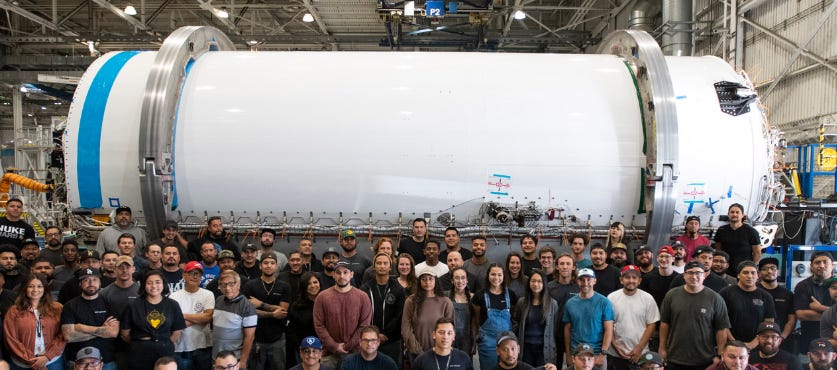
You may get a chance to see it. The explosion may not involve much rocket propellant, since essentially all the highly purified kerosene and liquid oxygen in the upper stage (shown above with more people than are near it now) was exhausted on completion of the final burn to put two spacecraft on the Moon in early 2025. However, the lithium-aluminium alloy is destined to heat well beyond its complete melting point.
Here’s what to expect. Roughly 23:35 or 11:35 p.m. in Los Angeles a Falcon 9 upper stage much like the one shown above is going to hit the surface of the Moon. Probably give yourself a window of twenty minutes to either side, though the expectation is the timing is between five and ten minutes either way.
The upper stage is about the height of a four story building made by Americans, or just over 39 feet. It will be moving at 5,400 miles per hour which is comparable to about 7.6 times the speed of sound in Earth’s atmosphere at 20,000 feet. Of course, there is no “air” as such surrounding the Moon. But there is lunar regolith and at that speed this object is gonna carve a hole 89 feet deep into the “dirt” there. It will hit with an impact energy equivalent to 6,000 pounds of tri-nitro-toluene (TNT).
It seems quite likely that temperatures exceeding 4,500 Fahrenheit are possible. The large plume of material from the impact is going to include tons of tiny particles of dirt that is about 40 to 45% oxygen, providing plenty of oxidiser for the fuel brought as lithium-aluminium. This metal is likely to not be merely melted (about 1200 F would be enough to melt all of it) but heated beyond its evaporation temperature into gas. So, a sort of fuel-air bomb is likely to go off in that enormous plume of material. That plume should be about fifty to sixty miles high or a bit more than 2% of the diameter of the Moon. Even as a dark plume of material it should be visible with your binoculars or small telescope. If, as I surmise, it flames, the rocket metal should flare as a white heat with crimson highlights. The dominant fuel in the fire is whatever oxide is present in the regolith where the upper stage hits and sends about 2.5 million pounds of stuff upward. The top five oxides in lunar regolith are silicon dioxide, aluminium oxide, iron oxide, calcium oxide, and magnesium oxide. So, more or less thermite or flare materials, including that magnesium kicker to boost the intensity and calcium for a bright orange flame.
I cannot promise that you’ll see a bright fire on the edge of the Moon when this thing hits, but you might. Anyway, it isn’t long from now (the evening of what y’all call “Tuesday” at 11:35 p.m. West coast time.) So you’ll see, if you go outside to look, allowing for clear skies. You’ll be looking at a “waning gibbous” moon which should show about 68% of the surface area of a full moon. Here is the approximate place to “look” with the impact near the edge as indicated.
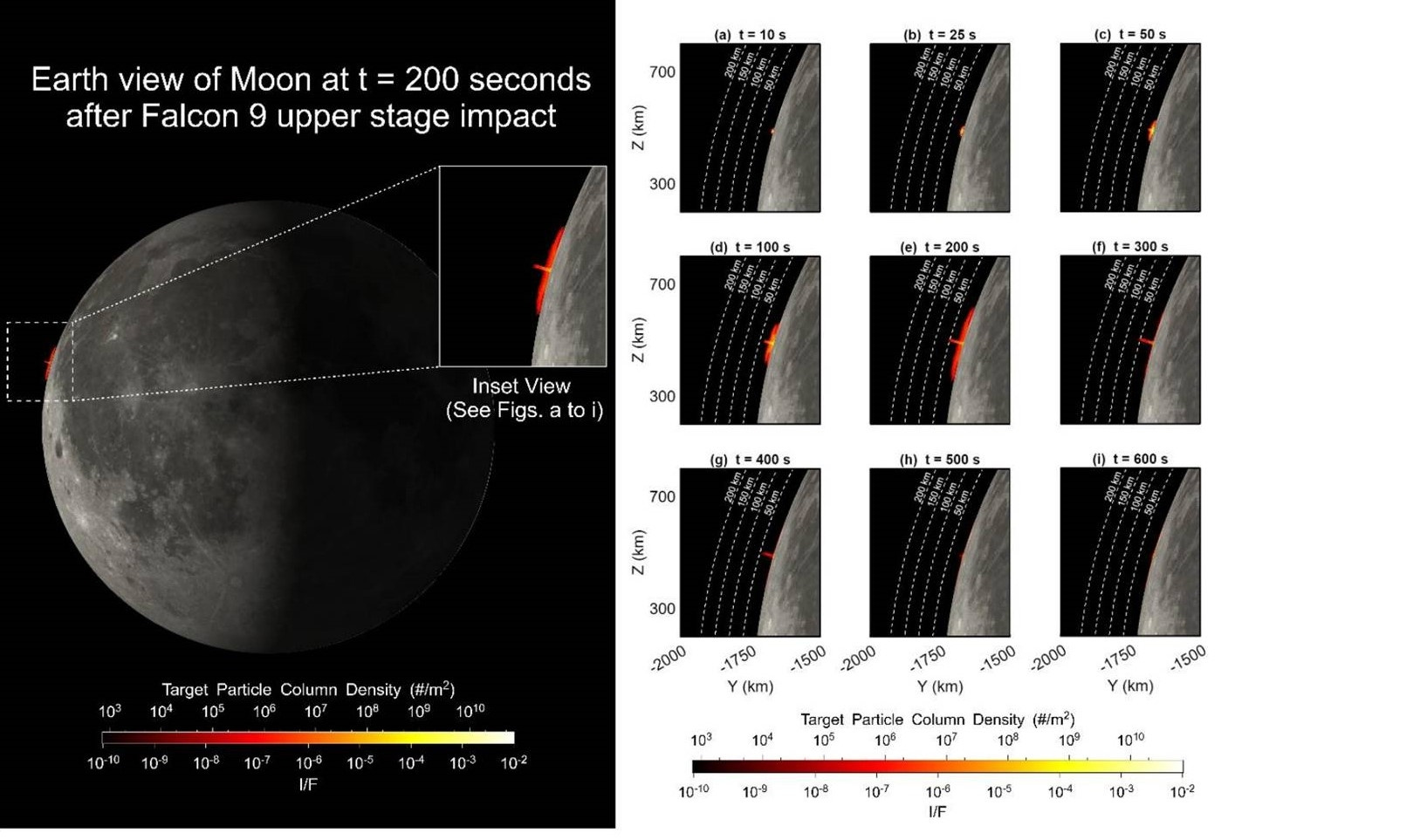
The predicted August 5, 2026, impact site of the Falcon 9 upper stage is located near the lunar Einstein Crater. So if you are familiar with the lunar surface, that’s where to look for the impact. In an upcoming article, I plan to offer some thoughts on the group that has been looking for such impact events and other incoming objects, and how that relates to the SkyWatch project.
Will there be ignition and a flaring? Hard to say. The energy of the impact is estimated at about 14.5 billion joules or around 13.7 million BTU. The materials will not necessarily be mixed and the oxygen won’t be as accessible as the oxygen in Earth’s air is to combustion here, though the oxides have a higher percentage (40 to 45 percent) than Earth’s air (about 21% at sea level). The fireworks-type chemicals involved in the upper stage metals and the lunar dirt suggest the possibility of a nice flare flaming as the material ascends and going out as it disperses and falls back to the lunar surface.
Would you be able to photograph or film the event? Sure! But how it looks when you play back that image or recording isn’t at all clear from the available info. So, feel free to restack this post next week and add your images. If you wish, we can publish a few such images in a future article here on L5 News. I’ll do my best to correctly credit the photographer or camera operators. We don’t have any budget to pay for these materials, so if you think your stuff would sell, you might contact local or national hoax stream media outfits. Be sure to get paid before you send them the stuff, as I don’t entirely trust those sorts of enterprises.
Good viewing! Looking up is its own rewards.
That’s all I’ve got for today. Come back next time when I have something new. Or old.
Thanks for the details and the heads up on this event. I hope the moon has cleared the trees by 11:35pm so I can get a clear view.
Jim,
Is this being performed for potential mining? My guess is mass spectroscopy to evaluate elements on the moon? It will tell how percentages of trapped gasses as well? Interesting topic, and thanks for writing about it! Public science for humanity on Earth! I'm betting the timing will negate some of the benefit of research to folks on the other side of the planet unless they have research vessels at anchor in our hemisphere to capture the event? IDK. Very interesting topic!!!!