
Build the SkyWatch
for fun and #BuildClub

“The ancients were correct in their belief that the heavens and the motion of astronomical bodies affect life on earth, just not in the way they imagined. Sometimes those heavenly bodies run into Earth. This is why we must make it our mission to find asteroids before they find us.” ~ Martin Rees, 2014 commemorating “Asteroid Day” project
On Bastille Day 2026 our publisher received from Enon Harris a document describing a new project. The date is significant since the people of Paris chose to destroy a nest of evil men who were torturing political prisoners for the national state on that same date in 1789. The new project, named SkyWatch, proposes to monitor the entire sky with arrays of mass-produced open source hardware and working with open source software projects. It offers the opportunity to become aware of orbiting surveillance assets, flying vehicles including drones, other monitoring devices in the sky around us, and possible impact events coming our way. Implementing it in a decentralised manner would give the most people the opportunity for defending themselves against the worst aspects of the surveillance state.
Overview
Project SkyWatch aims to monitor the whole sky using arrays of mass-produced telescopes at tens to hundreds of locations around the globe for planetary defense and long-term, comprehensive astronomical data compilation. These telescopes will continuously watch for: missiles, aircraft, spacecraft, satellites, space junk, transient astronomical and meteorological phenomena, asteroids, meteors, and anything else there is to be seen. The SkyWatch array will build up an integrated model of the heavens by integrating exposures of every arc-second of sky over periods of years, even decades. It is intended to be open, anyone will be able to view any part of the sky, in real time, live, or at any time in the past, with fantastic resolution.
The sky is big: 41,253 square degrees in a sphere. Usually no one is watching any given direction, certainly not very closely. To resolve one-metre objects at 100 kilometres in every direction requires at least 125 gigapixels, and to catch brief reflections of orbiting objects and correct for optical air turbulence requires 30+ frames per second. To allow triangulating distances to near-earth object flashes requires many-fold redundant coverage of the sky, with observation draft designs of hundreds of meters to thousands of kilometers between near-hemispherical clusters, each cluster of hundreds to thousands of telescopes, each telescope in a cluster covering a few square degrees of sky with a few megapixels of video. Depending on design, the total number of telescopes may be anywhere from tens of thousands to millions, costing anywhere from $100 million to $10 billion in total. If we are able to get 3 million telescopes for about $3,333 each (well within reach of many households and some student budgets) that would total $10 billion.
The SkyWatch engineering goal is: get maximum real information per dollar from the integrated system over decades. Achieving this goal requires not only combining current optical and electronic technology from several industries, such as: scientific and industrial imaging, consumer photo, video and cellphone cameras; data-centre networking and GPU computation and fibre and satellite wide-area networking; but also going beyond current commercially available technology, bringing advances in optics manufacturing, image sensors, electro-mechanical, and computational imaging systems into mass production.
The cost-optimised, rugged, sealed, sensitive and high-resolution electronic telescope design needed for SkyWatch has other potentially large markets including outdoor recreation, sports, and video production use of camera arrays.
Basic design philosophy
Substitute computation, electronics and low-cost, high-volume manufacturing methods for traditional astronomical telescope design and manufacturing practices, taking inspiration from the engineering of cameras (e.g. the 125x zoom Nikon P1100) and cellphone telephoto modules.
The design should favour:
compact molded, pressed, or hybrid optical elements;
large production volumes;
modular use in arrays.
Related projects
In our most recent issue, L5 News profiled an upcoming event when a Falcon 9 upper stage is expected to impact the lunar surface at a place and time when that impact point is in daylight and visible from much of America. How was that object’s impact date and time calculated? It was established by a project put together by astronomer and software developer Bill Gray. He has chosen the very unfortunate name of the Greek demon associated with death, and calls his project “Project Pluto.” Although death is a potential consequence of a very large impact event, the planet discovered by Clyde Tombaugh is unlikely to be involved in sending impacting materials our way. All things named for demons like “tues,” and “thor,” and “janus” would be better called by other names. That’s especially true for planetary bodies.
Here is some information on the project from its founder. Guide and FindOrb
There are also a number of projects that are doing a more or less mediocre job of tracking objects that orbit Earth, are in Earth crossing orbits, or may come to be in Earth-crossing orbits depending on various perturbing factors. As you can imagine, the various nation states pretend to keep an eye on such things. As you can surmise, the existence of many of the spy satellites they use to watch you and track you and find ways to hurt you aren’t widely published. Characteristic orbits, such as sun synchronous polar orbits, are understood by orbital mechanics and astronomy types, as well as by some of the people involved in environmental studies.
Here are a few of the identifiable projects you might look at for more information.
Asteroid Day is a united nations sanctioned global awareness campaign held annually on the 30th day of the 6th month to educate the public about asteroids, their role in the solar system, and the importance of planetary defense. Co-founded by Brian May, Rusty Schweickart, Grig Richters, and Danica Remy, it marks the anniversary of the 1908 Tunguska impact. You might find some videos and articles on Tunguska interesting, because an entire forest of trees was flattened when something blew up in the atmosphere over a remote area. Asteroid Day probably never came to your attention, which should cause you to question whether the money being spent on it is getting much traction.
Planetary Defense Coordination Office is run by nasa. It purports to manage efforts to detect and track hazardous asteroids and comets.
NEO Surveyor is an upcoming dedicated infrared space telescope designed to discover hard-to-find potentially hazardous asteroids, slated to launch no earlier than late 2027. (The acronym “neo” probably refers to near earth orbiting objects.)
Centre for Near-Earth Object Studies calculates high-precision orbits and maps close approaches using automated systems like Sentry (for long-term risk) and Scout (for immediate impact warnings. CNEOS provides raw data access and automated query tools through documented jet propulsion laboratories solar system dynamics application programming interfaces so anyone can pull the tracking data.
Planetary Defence Office is run by the European Space Agency. It purports to coordinate European observation campaigns and operates automated telescopes like the upcoming Flyeye system.
Catalina Sky Survey is a project with nasa (taxpayer) funds in Arizona that uses specialised telescopes seeking to discover a large percentage of near-Earth asteroids each year.
Pan-STARRS are wide-field astronomical observation networks in Hawai’i scanning continuously for moving objects
ATLAS is Asteroid Terrestrial-impact Last Alert System. It is supposed to be a robotic warning system optimised to catch smaller objects days to weeks before a potential local impact.
Vera C. Rubin Observatory is an advanced ground-based observatory designed to vastly increase the rate of overall asteroid and transient object discovery.
Can you be involved?
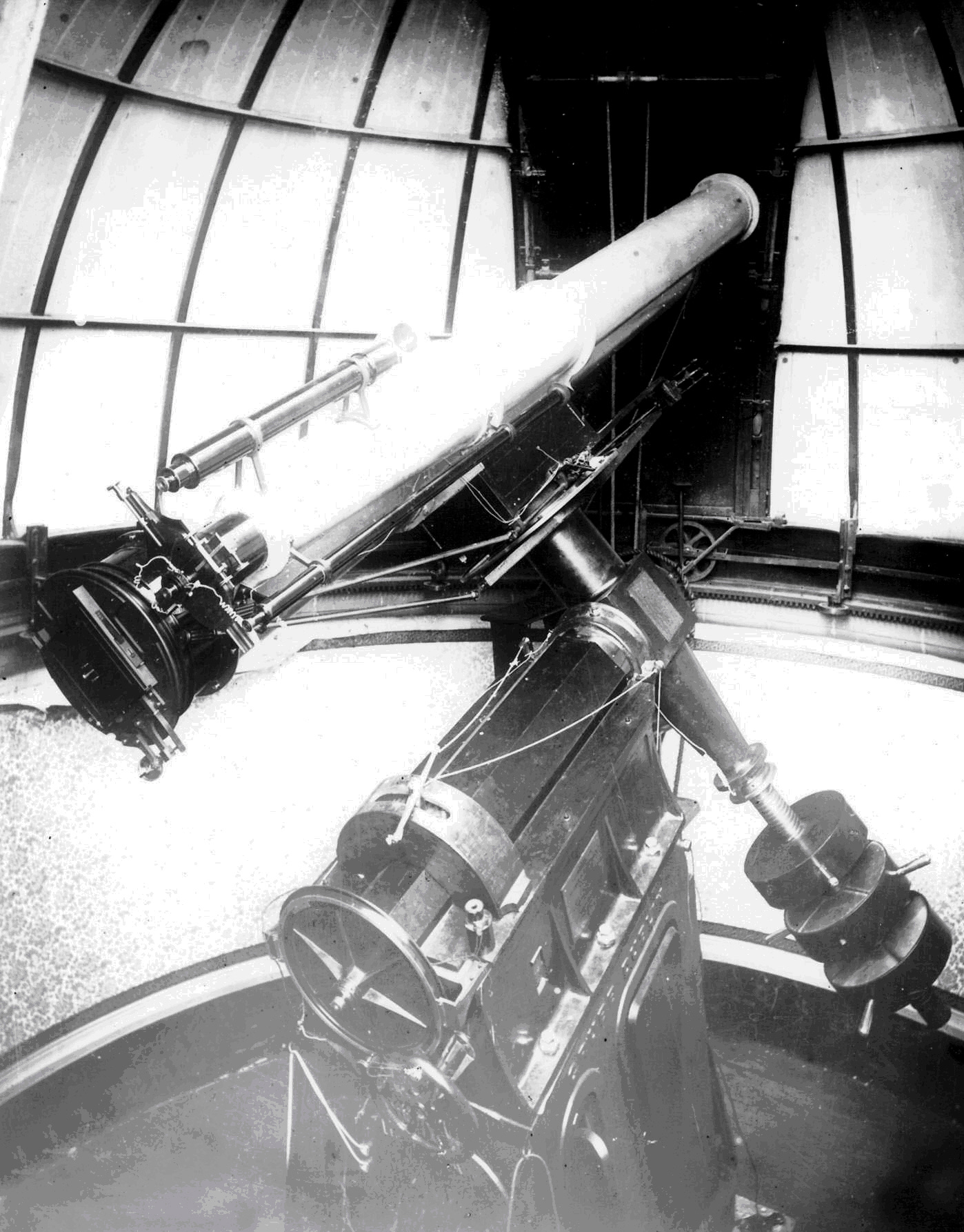
Yes. At the top of this essay is an image of a telescope somewhat similar to a twelve-inch telescope owned by some friends who built their own dome observatory next to their home. The lens used for this particular photo appears to distort the size of the clock drive and mount structures. Nevertheless, amateur astronomers have had effective equipment for a great many centuries. For example, Nicolaus Copernicus is widely recognised as the first major renaissance polymath and amateur astronomer of the post-1400 era who pursued astronomy as an avocation while earning his primary living as a church canon and physician. His active years in astronomy spanned roughly from 1508 to 1543. His telescopes were much less sophisticated than the one shown above.
One of our friends in this project is proposing to develop a crowd funding strategy to help with putting together the hardware specs, the systems, the software, and the communications systems needed to keep things going.
It should be clear to you that SkyWatch is potentially a threat to the agencies and people who want to enslave and torment everyone on Earth. So, keep that in mind going forward.
We plan a series of articles and essays about SkyWatch in coming weeks.
That’s all I’ve got for today. Come back next time when I have something new. Or old.
Thanks for posting about Skywatch, Jim.
There are some challenges:
* mass-produced small telescopes (2" class) with high cost/performance ratio need significant up-front engineering and tooling investment, lots of precision molds, also custom microactuators and sensor chips. Just drafting the budget is well into six figures. Actually manufacturing the first telescope is seven. These can potentially earn back their investment with sales for other purposes, though.
* The larger telescopes (3.5" and up) are much more expensive, thousands of dollars each, even using every trick to get the most for the money.
* The local networking and processing needed is a significant part of the total cost; even making the telescopes as chaply as I hope to, networking, processing and local power may easily cost more than the telescopes. The raw data flow is massive and needs to be winnowed down a great deal to allow the real information in it to be used to update the local stored history and sky model and to make the diffs small enough to transmit out.
* There need to be many observatory sites roughly equally spaced around the globe, particularly to get good low-orbit tracking. For GEO, maybe only 90 sites, for LEO, even to get 1/6th of each orbit covered by two sites, about 500. Each site needs to cover 40k-60k square degrees to get fair triangulation and to be sure a pixel blip isn't noise or a glitch. Each square degree needs about 0.25-5 megapixels, at 20-60 frames per second to cope with atmospheric turbulence and to record transient events. Even pared to the bone, it's close to $1M/obsevatory, $10M or more would be closer to reality. Many need to be in oceans. These need frequent maintenance and probably on-site staff and cost much more. The whole system is billions of dollars.
* The US Navy is the top candidate for servicing those remote ocean sites, but if it's a US military project, we can't get the sites we need in China, Russia and other places. There are political / diplomatic strategic problems on top of funding and technical.
* The only way to get the data out in realtime from most sites is Starlink, or another future competing satellite constellation. Nearly all the bandwith we need is in places where the satellites have nothing to do, though, and the observatories could be quite useful to the network by acting as ground stations. Elon Musk has more of an interest in keeping an eye on what's in orbit and beyond than anybody, he's the top prospect for backing. Next best is an international project, but the meetings, the paperwork ... and the military, Navy in particular, is at least as bad. Then there's the possibility of lobbying for funding from Congress. Or VCs. I'm not excited about selling any of these, but if I'm supposed to be the sales guy any project will be in trouble.
Thanks for sharing this project in more detail. One idea for continued funding once Skywatch is up and running, would be to charge weather reporting, for profit enterprises, such as the weather channel and news shows, for using the data and accessing the systems. It could atill be free to everyone that isn't making a buck off it, similar to how free use software has worked.